
Modern SOCs are drowning in millions of static Indicators of Compromise (IOCs), with many estimating that 85% offer zero actionable telemetry. 60% of SOCs struggle to operationalize threat intelligence feeds (SANS 2025 CTI Survey). True risk reduction requires shifting from reactive data ingestion to CTI-driven, validated threat hunting and purple teaming. At the same time, adversaries are rapidly weaponizing AI while organizations are left in a daze, confused, unsure what to do next, as risk increases daily. CTI teams struggle to be integrated with notable return on investment (ROI), requiring a change to the status quo of operations in the industry today.
Drowning in Data Without Tradecraft
Everything is smart and has a log. SOC analysts are left feeling like parents at the end of the day at a theme park with ten kids in tow, worn out and overwhelmed. The complexity of validation is through the roof in 2026, with so many different types of hardware and software in different architectures: legacy, cloud, and mobile with varied operating systems. Tuning and achieving a signal-to-noise (SNR) ratio that is good to great for the SOC is a huge, continual task that requires constant adjustment.
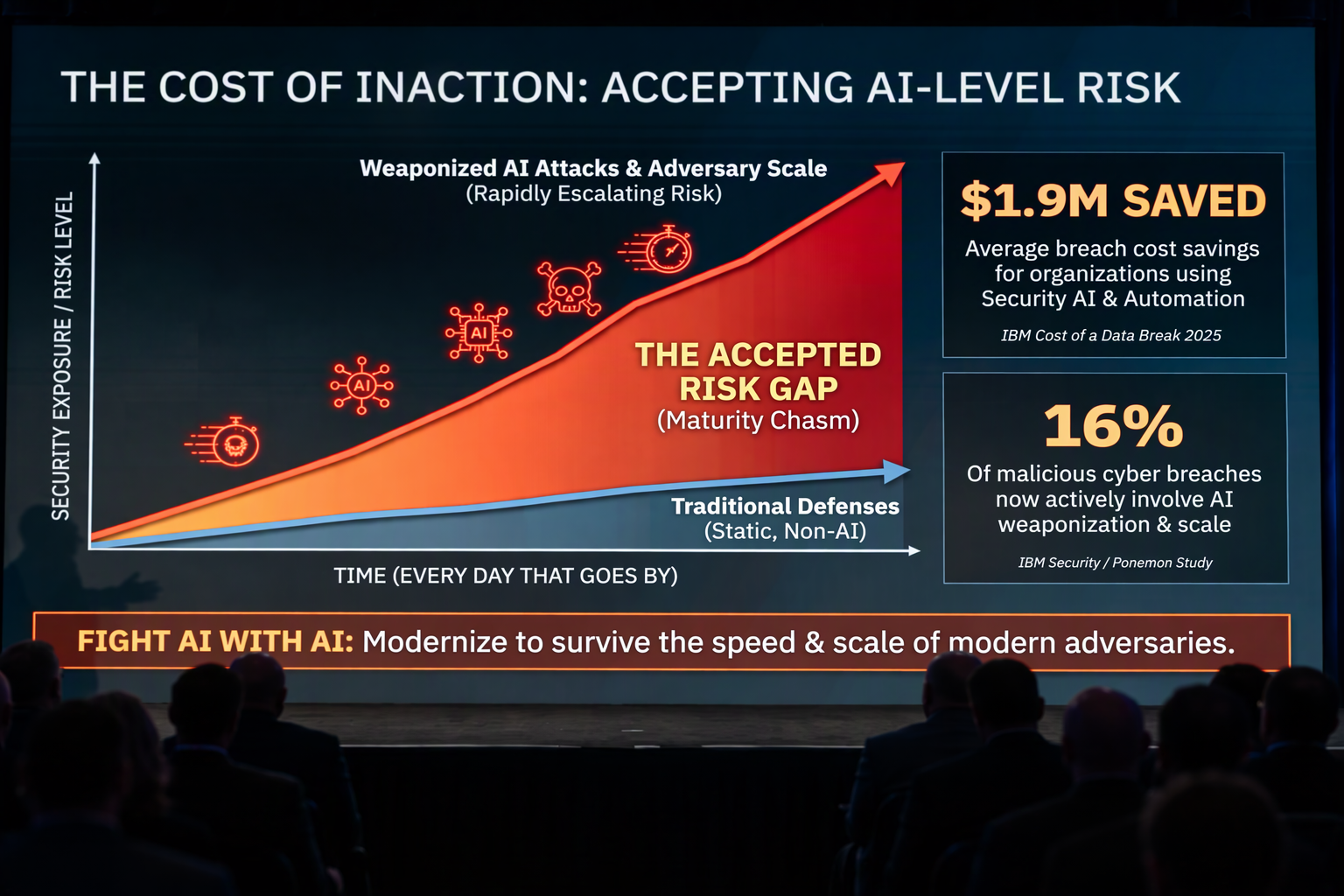
AI Inaction Risk
The advent of AI and rapid weaponization by adversaries dramatically increases risk for organizations daily. While adversaries are using AI to increase speed, scale, and creativity of attacks, SOCs are often confused about how to best embrace or restrict AI, how to modernize, and next steps. A prime example exists in the world of threat and vulnerability management (TVM) where an average 14-day window previously existed following the release of a patch before exploitation took place. Today, with the use of AI, exploitation takes place on the same day as the patch. This demands that organizations radically transform ASAP to use AI to fight AI.
Threat Hunting Without Tradecraft
A notable number of new analysts in our modern culture and industry have incorrect biases, beliefs, and training related to Cyber Threat Intelligence (CTI), threat hunting, and how to effectively and efficiently research and respond to threats. Many equate looking up information about an indicator of compromise (IOC), such as an IP address for possible malicious hosting or similar indicators, with threat hunting, when in fact it is far from it. In most cases, IPs seen in logs are often one-time-use IPs used in large-scale attacks that will have no abuse history and yield little to no results upon reputation lookup or similar metadata. More importantly, chasing IOCs instead of using a hypothesis-driven way of thinking and doing in your analytical tradecraft is a setup for failure in operations.
Skilled CTI experts construct hypotheses related to available data and information, build context towards one or more hypotheses, and quickly identify what is proven or disproven, towards threat hunting. IOCs are part of this journey but not the focal or starting point, as seen with the tradecraft of so many in 2026. Skilled practitioners know their answers have trust and credibility and can rely upon it when the junior staff are confused, wonder, and must ask more senior staff, “Did I get it right?” or ask them to check their work. We must do better, with the help of trained professionals and AI, to enable our staff to become AI Directors (Using AI as a trusted digital teammate to improve productivity, scale expertise, and deliver outcomes faster).
Prioritize CTI
CTI always starts the lifecycle of support for a business unit or organization with a Priority Intelligence Requirement (PIR). 4D5A Security then maps this to specific, measurable key performance indicators (KPIs) and diagnostic metrics to support each KPI, to strategically reduce risk and counter prioritized threats to the organization. This requires that additional work be performed to qualify and quantify the personalized threatscape of the organization.
Personalized Threatscape
Start by identifying threats and actor groups that target your sector. Map out tactics, techniques, and procedures (TTPs) related to each, overlap, and identify where each threat targets your organization. If you have ten threats and five of them all perform lateral movement, that may be an area you want to focus on to ensure it is hardened. From a risk perspective, consider impact and likelihood for how an adversary may compromise and exploit the network and assets that most impact your business risk goals (reputation, downtime, financial losses, etc). Lastly, and most importantly, look at your detailed logs (network, endpoint, antivirus, etc.) to see what threats have been blocked and what groups and threats they are related to. If you have populated IOCs from prioritized threats into your technology stack and/or see instances in the logs where threats are confirmed, that becomes a higher priority. This is a continual process to baseline prioritized threats and adjust over time, as you threat hunt and manage your threatscape reality.
Design Metrics for Success
Metrics must strategically support your risk reduction plan, commonly focused on mean time to detect (MTTD), mean time to respond (MTTR), and return on investment (ROI). The image below reveals four primary categories of metrics for SOCs, with integrated CTI-driven support, where you can design, test, and drive maturity for SOC teams:
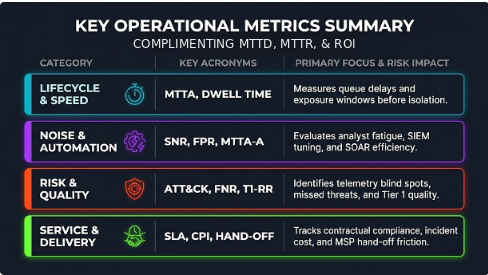
- MTTD (Mean Time to Detect): Average time required to identify a threat or security incident.
- MTTA (Mean Time to Acknowledge): Average time before an analyst begins investigating an alert.
- MTTC (Mean Time to Contain): Average time required to isolate and stop an active threat.
- Dwell Time: How long an adversary remains in the environment before detection.
- SNR (Signal-to-Noise Ratio): Measures the proportion of actionable alerts versus alert noise.
- FPR (False Positive Rate): Percentage of alerts that are investigated but determined to be benign.
- ATT&CK Coverage (ATT&CK): Degree to which security controls detect and respond to MITRE ATT&CK techniques.
- FNR (False Negative Rate): Percentage of malicious activity that is missed by detection controls.
- TT-RR (Time to Risk Reduction): Time required to implement mitigations that measurably reduce exposure.
- SLA (Service Level Agreement): Performance commitments for response, resolution, and service delivery.
- CPI (Cost Per Incident): Average operational cost incurred to investigate and resolve a security incident.
- Hand-Off Rate: Frequency and efficiency of incident transfers between teams, providers, or escalation tiers.
CTI-driven Purple Team Validation
Purple teaming is traditionally performed by the red team in coordination with blue, CTI, and 3rd party providers. When CTI is the driver of the design, testing, and remediation of purple teaming, the focus changes from compliance, regulatory oversight, and security to specific, qualified, and quantified risk management against threats specific to the organization. For example, the CTI team may have identified in logs brute-force attacks attempted by a specific group, or a high number of ransomware attacks, warranting a purple team demonstration of tools, processes, and people in operations ready to respond to specific TTPs related to those threats.
4D5A Security uses the following CTI-driven purple team process to map personalized threatscapes to TTPs to systematically and iteratively demonstrate maturity and/or remediate discovered gaps against prioritized threats:
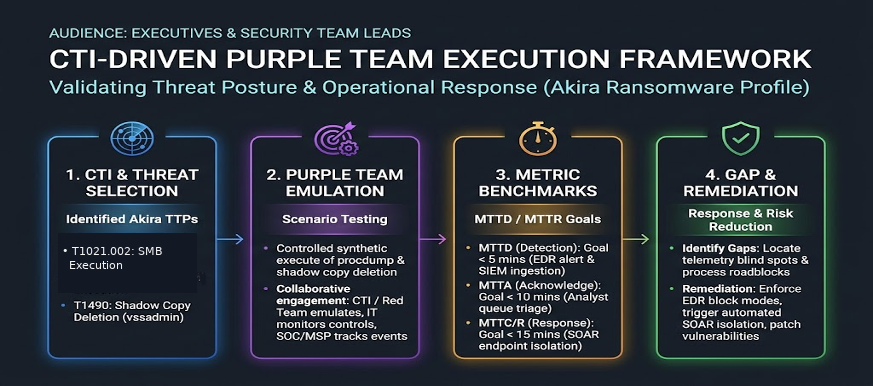
The above process is continual, requiring support of multiple teams, to identify and remediate gaps as an organization reduces risk to the left of boom.
Conclusion
Overcoming intelligence fatigue and operational drag is not a matter of ingesting more data; it is a matter of analytical tradecraft, structural integrity, and continuous validation. By integrating AI as a partner to enable humans as the AI Director and placing CTI at the center of purple team execution, security organizations can systematically validate controls against prioritized threats, build analyst confidence, and prove tangible risk reduction to executive leadership.
Contact 4D5A Security to learn how we can help you stand up purple team operations, perform defensive assessments, and more.